
Japan’s logistics-to-AI experiment starts at 520 kW
A 520 kW IT container at Landport Takatsuki is a deliberately bounded test of whether a property owner can operate and repeat GPU hosting.
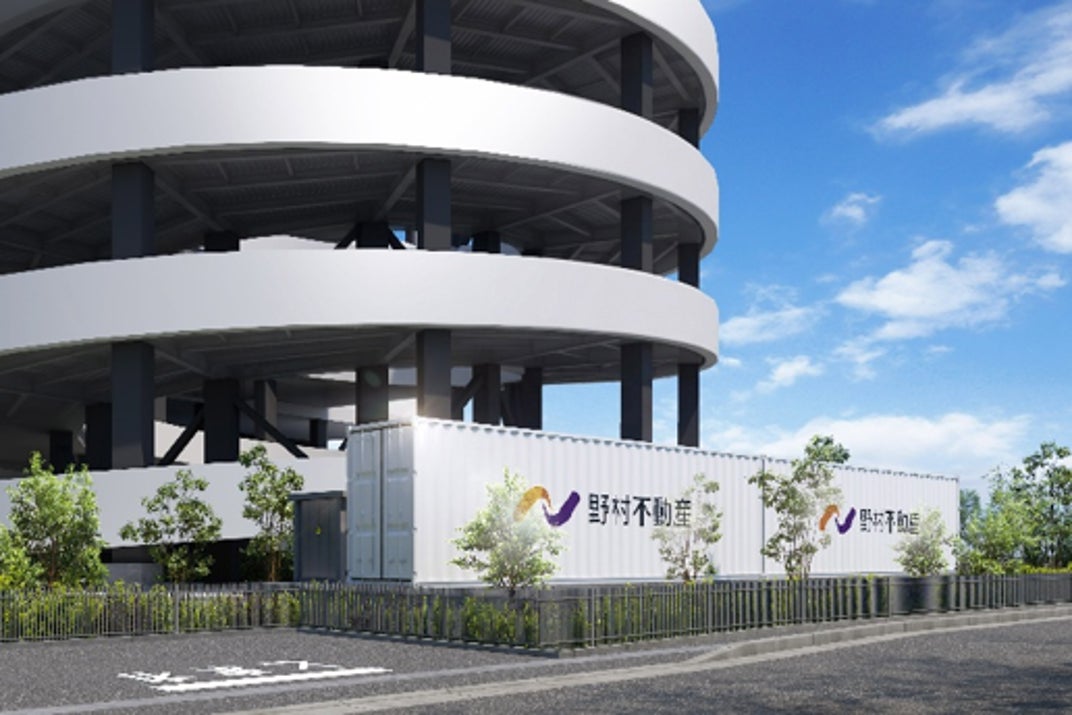
A 520 kW IT load is small beside the multi-megawatt campuses now associated with artificial intelligence. That is precisely why Nomura Real Estate’s first containerised GPU facility deserves attention.
On 12 November 2026, the Japanese property group said it would install a container data centre at Landport Takatsuki, a logistics property between Osaka and Kyoto. The system is designed for about 710 kW of total electricity consumption, including roughly 520 kW of IT load. Nomura plans to own both the container equipment and 32 servers fitted with NVIDIA Blackwell Ultra GPUs. Mirait One will design, build and maintain the facility. Direct liquid cooling is specified, construction is expected to take about eight months, and operations are targeted for summer 2027.
The announcement is not evidence that logistics warehouses can become data centres at scale. It is evidence that a property owner can buy a bounded amount of operating knowledge before committing to scale.
The first asset is a learning instrument
Nomura is entering a business that sits between real estate, electrical engineering and managed computing. Those disciplines do not share the same commercial clock.
A logistics developer normally secures land, constructs a building and leases space. A GPU hosting operator must also select hardware, manage heat, secure network performance, match contracts to rapidly changing equipment, and keep utilisation high enough to recover capital. The Takatsuki project keeps that first experiment deliberately narrow. Its 520 kW IT load is large enough to expose real operating problems, but small enough to avoid betting a conventional campus on an untested service model.
The separation between electrical consumption and IT load matters. Nomura states approximately 710 kW for the facility and 520 kW for IT. The difference is about 190 kW at the announced design point. Dividing total facility power by IT power gives an implied design PUE of about 1.37. That is a calculation from the published figures, not a reported operating result. Actual efficiency will depend on utilisation, weather, pumping, electrical losses and the way the cooling system is run.
| Announced item | Takatsuki first project | What still needs proof |
|---|---|---|
| Total electricity consumption | About 710 kW | Connection conditions and metered peak |
| IT load | About 520 kW | Commissioned usable load |
| GPU servers | 32 Blackwell Ultra systems | Exact configuration and customer allocation |
| Cooling | Direct liquid cooling | Operating temperatures and partial-load performance |
| Construction period | About eight months | Start date and delivery milestones |
| Target service date | Summer 2027 | Commissioning and first contracted workload |
That distinction is important for investors and customers. A server count is not capacity, and design power is not delivered computing. The commercial product only exists when the facility, network, cooling and service organisation work together under load.
Why a logistics site can be useful
Landport Takatsuki offers three advantages that are more valuable for a pilot than for a hyperscale campus.
First, the site already belongs to an operating logistics platform. Nomura is not beginning with a speculative land search. It can test how digital infrastructure fits with an asset it understands, while using its existing relationships with contractors, utilities and local stakeholders.
Second, the Osaka–Kyoto location gives the project access to a substantial business and research market without requiring the first installation to compete directly as a massive wholesale campus. AI development, simulation, image processing and other hosted workloads can benefit from proximity and operational access even when they do not require the ultra-low latency of an exchange building.
Third, the container format shortens the feedback loop. A conventional building can lock design assumptions into concrete and electrical rooms long before the customer mix is known. A smaller modular system lets Nomura observe power density, liquid-cooling maintenance, hardware refresh cycles and customer demand before repeating the format.
This is an option on a wider portfolio, not a claim that every warehouse has spare power. The group says it will consider other Landport locations and links with its energy business after learning from Takatsuki. That sequence is sensible. Replication should follow evidence from the first operating asset, not a map of roofs and yards.
The economics depend on utilisation, not empty space
Reusing space sounds inexpensive, but available floor area is rarely the binding constraint for AI infrastructure. Power availability, electrical quality, cooling, fibre routes, security, noise, permitting and maintenance access can all dominate the decision.
Nomura also intends to own the GPU servers. That changes the risk profile. The company is not merely leasing a powered shell to a specialist operator; it is taking exposure to the computing equipment and the hosting service. Blackwell Ultra systems can command high revenue when demand is strong, but the capital depreciates faster than a logistics building. A delayed opening, slow customer ramp or poorly matched contract term can therefore damage returns even if the property itself remains useful.
The economic test is straightforward: can contracted gross margin over the effective life of the GPU fleet cover equipment depreciation, electricity, network, cooling, maintenance, software and the cost of capital? The press release does not disclose capital expenditure, pricing, contracted customers or utilisation. Those fields should remain unknown.
There is nevertheless strategic value in the ownership choice. A landlord that only provides space learns about construction. A landlord that owns the computing stack learns which customers buy capacity, how they specify workloads, what service levels they require and how quickly they refresh hardware. That knowledge can inform future decisions about whether to remain an operator, partner with a cloud or GPU specialist, or develop larger sites for third parties.
A different route into Japan’s AI infrastructure market
Japan’s largest digital-infrastructure projects are usually framed around large campuses, cloud regions and major power reservations. Takatsuki represents another route: a property company begins with a small, liquid-cooled GPU service embedded in an existing industrial portfolio.
That route could matter if it creates repeatable demand near users who cannot wait for a large campus or do not need one. It could also give regional enterprises a more direct way to procure hosted GPU capacity for simulation, machine learning or visual workloads without buying and operating the systems themselves.
But a distributed network of small installations is not automatically cheaper than a centralised campus. It can duplicate operations, spares, security and network connections. Procurement scale may be weaker. Capacity may fragment across locations, making scheduling harder. The model becomes attractive only where proximity, deployment speed, customer control or use of an existing constrained site offsets those disadvantages.
The serious objection is therefore not technical. Container data centres and direct liquid cooling are established approaches. The objection is commercial: a 32-server facility can prove that hardware runs, but not necessarily that a property company can sustain high utilisation and service quality across a national fleet.
What buyers and partners should examine
Customers evaluating the Takatsuki service should ask for the operating envelope rather than treating “Blackwell Ultra” as a complete specification. GPU model, server architecture, interconnect, storage, network topology, orchestration, tenancy model and support responsibilities determine which workloads can run efficiently.
Energy buyers and investors should also separate the project’s three layers:
1. The property layer: site control, permits, physical security and residual use. 2. The facility layer: grid connection, electrical distribution, cooling and availability. 3. The compute layer: GPU configuration, software, contracts and utilisation.
A good result at one layer does not validate the others. A completed container is not a commissioned service. A commissioned service is not a contracted fleet. A full first fleet is not proof that the model transfers to another Landport asset with different power and fibre conditions.
For Nomura, the most valuable outcome may be a disciplined decision rule for the second site. The company should be able to say what minimum grid headroom, network redundancy, local demand and contract coverage justify another deployment. Without that rule, “national expansion” remains an aspiration.
The milestones that would change the thesis
The 12 November announcement establishes ownership, design intent, equipment class, power figures, construction duration and a target operating window. The next evidence should be operational.
The first milestone is a confirmed construction start and a clear connection plan. The second is commissioning at the stated electrical and IT loads, with the 710 kW and 520 kW figures kept distinct. The third is customer evidence: contracted workloads, not only expressions of demand. The fourth is operating data on availability, cooling performance and utilisation after launch. The fifth is a named second site selected using lessons from Takatsuki.
If those milestones arrive, Nomura will have demonstrated more than an experiment in a logistics yard. It will have built a repeatable bridge between industrial real estate and AI compute. If they do not, the project can still be a useful pilot, but it should not be extrapolated into a national capacity pipeline.
The strategic point is that Japan does not need every AI infrastructure entrant to begin at campus scale. It needs entrants that can learn quickly without confusing a small first installation with a proven platform. Takatsuki is credible because it is bounded. Its value will come from what Nomura can measure, contract and repeat.
*By Matthieu Gallego*
Primary source: Nomura Real Estate, 12 November 2026. The announced 710 kW facility consumption, 520 kW IT load, server count, cooling method, ownership, contractor, construction period and target start date come from the issuer release. The implied PUE is PowerlandMap’s calculation from those announced design figures and is not an operating result.
The data behind the analysis
Follow Market Intelligence with sourced, dated evidence
Each analysis draws on qualified supply records, anonymised demand signals and evidence-based matching. The underlying records retain their sources, confidence levels and verification dates.
Related analysis
The UK's next data-centre bottleneck is integration, not just land and power
Computacenter's focus on rack integration, AI infrastructure and liquid cooling shows why UK data-centre value is moving beyond powered shells toward supply-chain execution and commissioned systems.
Greece is making grid access a capital test for data centres
Greece’s new electricity framework and PPC’s 240 MW IT / 300 MW electrical project at Agios Dimitrios show how grid guarantees, renewable obligations and local contributions are reshaping data-centre delivery.
Italy’s data-centre race is moving from announced capital to delivery capital
Retelit’s €50 million accordion increases funding flexibility. The investment case still depends on converting committed capital into commissioned capacity.