
The Grid Connection Is No Longer the Whole Power Strategy
Vertiv’s acquisition of UtilityInnovation Group shows why data center value is shifting from nominal megawatts to deliverable, orchestrated and economically sustainable power.
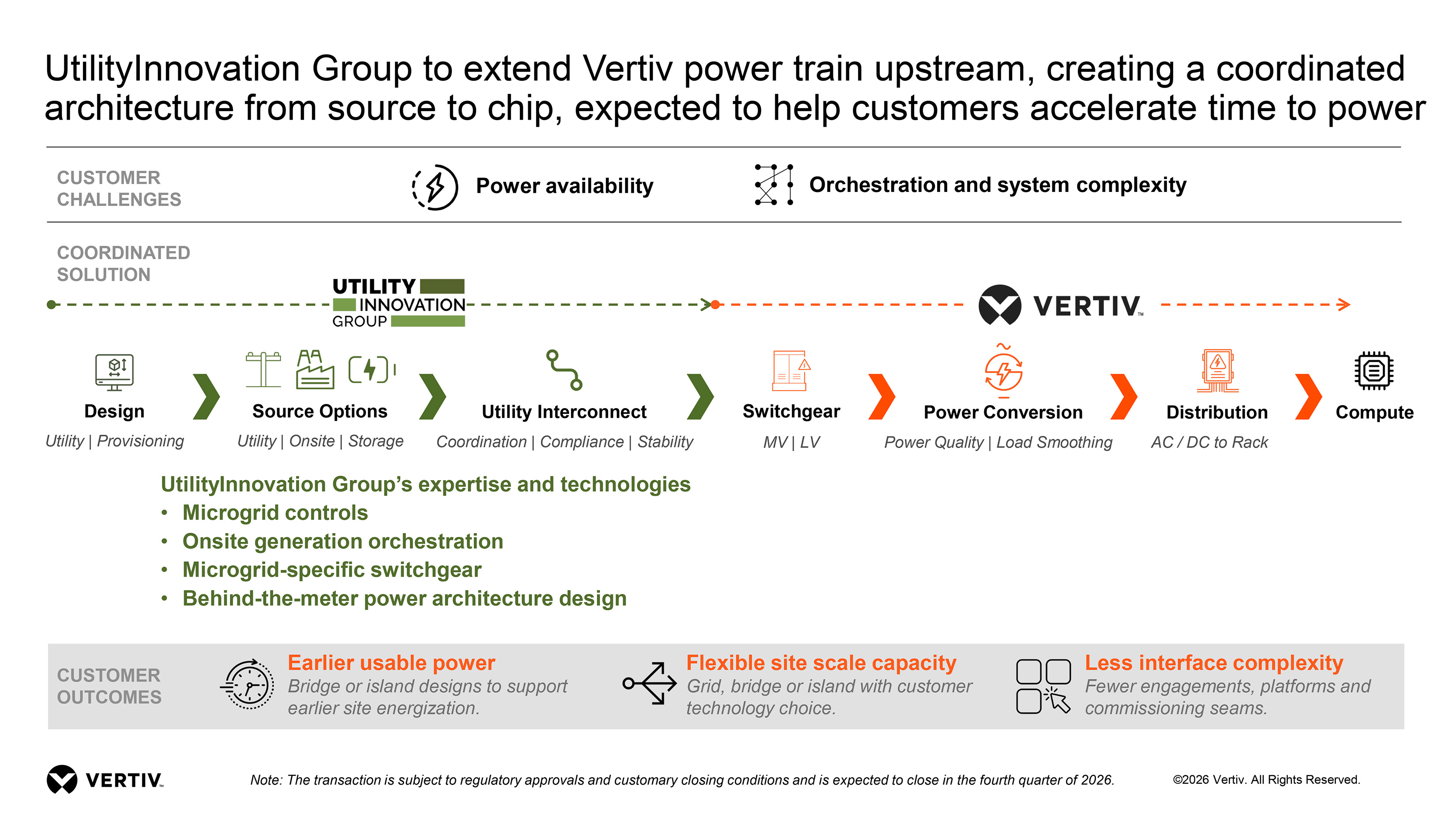
On 2 September, Vertiv announced an agreement to acquire UtilityInnovation Group for approximately $1.45 billion in cash, with up to $1.15 billion in additional performance-based consideration.
The transaction adds microgrid controls, onsite generation orchestration, specialised switchgear and behind-the-meter power architecture to Vertiv’s data center infrastructure portfolio.
This is more than an equipment acquisition.
It is a clear market signal that time to power has become one of the most valuable layers of the AI infrastructure stack.
Power Availability Is No Longer Binary
For years, data center opportunities were commonly described using a headline capacity figure:
- 50 MW available
- 100 MW connection requested
- 300 MW campus potential
These figures are no longer sufficient.
A grid application is not a connection agreement. Reserved capacity is not necessarily energised capacity. Electrical capacity measured at the grid interface is not equivalent to usable IT load.
The relevant question is no longer simply:
How many megawatts does the site have?
It is:
How much power can be delivered, at what point, on what date, at what cost and under which operating conditions?
From Grid Connection to Power Architecture
The acquisition extends Vertiv’s position upstream towards the grid interconnection.
That matters because AI campuses increasingly require a coordinated power architecture combining several components:
- Utility grid capacity
- Temporary or bridge power
- Onsite generation
- Battery energy storage
- Microgrid controls
- Electrical distribution
- Redundancy and resilience
- Load orchestration
These components cannot be evaluated independently.
A site may have an attractive grid connection date but an uneconomic tariff. Another may secure earlier bridge power but face fuel, emissions or operating-hour constraints. A third may have sufficient gross capacity but lose a significant portion before reaching the IT equipment.
The value therefore sits in the complete path from energy source to compute load.
Electricity Cost Must Be Measured at the Right Point
Electricity cost is becoming a decisive site-selection variable, but headline market prices can be misleading.
A credible data center power benchmark should distinguish:
1. Wholesale energy price 2. Network and transmission charges 3. Capacity and balancing costs 4. Taxes and regulatory components 5. Power purchase agreement terms 6. Conversion and distribution losses 7. Onsite generation costs 8. Storage losses and cycling costs 9. Redundancy and backup requirements 10. The resulting cost delivered to the IT load
Two sites located in the same country can therefore have materially different operating economics.
The lowest national electricity price does not automatically produce the lowest data center OPEX. Contract structure, voltage level, load profile, connection point and operating configuration all matter.
This is why PowerlandMap’s electricity and OPEX intelligence is designed to support comparison rather than replace site-specific energy due diligence.
Five Questions Every Powered-Land Review Should Answer
1. Is the capacity firm?
The evidence should distinguish an initial utility discussion, a submitted application, a technical offer, reserved capacity and a signed connection agreement.
2. When can the power actually be energised?
The contractual delivery date, enabling works, permitting dependencies and required grid reinforcement should be documented.
3. Where are the megawatts measured?
Capacity at the grid connection point must be translated into critical load and ultimately usable IT capacity.
4. What is the total delivered electricity cost?
The analysis should include both recurring energy costs and the capital required to make the power usable.
5. Can the architecture evolve?
Bridge power, storage and onsite generation should support the transition towards the final grid configuration without creating stranded electrical assets.
A Wider Structural Shift
The International Energy Agency reported that electricity demand from data centers increased by 17% in 2025. Its updated central projection sees global data center electricity consumption rising from approximately 485 TWh in 2025 to around 950 TWh by 2030, while consumption from AI-focused facilities could triple.
At the same time, JLL’s 2026 Global Data Center Market Outlook projects that global capacity could reach approximately 200 GW by 2030. JLL identifies onsite power and battery storage as increasingly important responses to grid constraints, with average connection waits in primary markets exceeding four years.

The industry is consequently moving beyond the traditional model in which utilities deliver power and data center developers consume it.
Developers, operators and infrastructure providers are becoming active participants in power generation, storage, control and optimisation.
What This Means for Powered Land
A parcel with a theoretical grid capacity is not yet powered land.
A credible powered-land opportunity requires an evidenced and economically viable route covering:
- Capacity
- Delivery date
- Connection milestones
- Infrastructure requirements
- Electrical architecture
- Energy cost
- Permitting
- Resilience
- Scalability
- Conversion into usable IT load
Vertiv’s proposed acquisition of UtilityInnovation Group confirms that these elements are increasingly becoming part of a single infrastructure proposition.
The next generation of data center platforms will not be differentiated only by land, buildings or even secured megawatts.
They will be differentiated by their ability to convert multiple power sources into reliable, scalable and cost-transparent compute capacity.
The PowerlandMap View
PowerlandMap tracks this transition by separating headline announcements from the evidence required to support an infrastructure decision.
For each market or opportunity, the useful intelligence includes:
- Reported and evidenced electrical capacity
- Current connection status
- Expected energisation milestones
- Grid and behind-the-meter architecture
- Conversion from gross capacity to usable IT load
- Electricity-price and OPEX indicators
- Development maturity and remaining dependencies
- Source date and confidence level
This makes it possible to compare opportunities on a consistent basis while preserving the distinction between public facts, structured observations and analytical estimates.
The Bottom Line
The Vertiv–UIG transaction reflects a fundamental change in the data center value chain.
Power is no longer simply a utility input secured after site selection. It is becoming an integrated development platform that combines grid access, onsite generation, storage, controls and critical infrastructure.
The most valuable sites will not necessarily be those advertising the largest capacity.
They will be those able to demonstrate the most credible path from headline megawatts to first usable compute, with transparent timing, cost and delivery risk.
Explore PowerlandMap’s market intelligence platform, review the subscription options or request access for a specific market or powered-land requirement.
Sources
Vertiv — Agreement to acquire UtilityInnovation Group, 2 September 2026
U.S. Securities and Exchange Commission — Vertiv Form 8-K
International Energy Agency — Data centre electricity use surged in 2025
The data behind the analysis
Follow Power & Grid with sourced, dated evidence
Qualified supply, anonymised demand and evidence-based matching sit behind each read — with the source, confidence level and verification date on every record
Related analysis
When Shoulder Season Disappears
Year-round data-center demand is eroding the grid’s traditional maintenance window. A practical diligence framework for delivery, resilience and expansion risk.
From Grid MW to Live IT Capacity
A six-level evidence framework for separating grid offers, electrical envelopes, designed IT capacity, commissioned supply and live data center load.
A Power Deal Is Not IT Capacity
A practical framework for separating generation, contracted supply, grid connection, facility electrical capacity and critical IT load.