
From Market Signal to Data Center Blueprint
PowerlandMap welcomes DCtoB as its first strategic technology partner, connecting data center market and power intelligence with conceptual design and engineering.

Matthieu Gallego · PowerlandMap · 8 October 2026
PowerlandMap and DCtoB are joining forces around a simple principle: a compelling data center opportunity should be tested against an equally compelling technical concept. Our new strategic technology partnership creates a coordinated path between PowerlandMap’s evidence-led market and site intelligence and DCtoB’s conceptual design technology.
Formalised on 7 October 2026, the collaboration names DCtoB as PowerlandMap’s first strategic technology partner and operates opportunity by opportunity. It establishes a basis for coordinated client introductions, project qualification, reciprocal platform familiarisation and separately scoped technical work. It is not a claim that the two platforms already share a live software integration, or that a qualified site is automatically developable.
For developers, operators, investors and engineering teams, that distinction matters. A power offer is not usable IT capacity. A land parcel is not necessarily a buildable campus. A promising market is not a final investment decision. The value is in connecting those questions early enough to challenge assumptions before major development expenditure.
The Missing Link Between Opportunity and Engineering
Data center development increasingly begins with conflicting information. Market demand is accelerating in some locations, but energy-network constraints, long grid programmes, permitting and specialist cooling requirements can change the economic picture. Early project presentations may combine land, utility capacity, facility load and IT capacity as though they were interchangeable; they are not.
At the same time, engineering teams are often asked to configure a building before the site’s power evidence, phasing and commercial requirements have been sufficiently defined. That creates avoidable rework. Layouts are revised when the grid connection changes; redundancy choices alter equipment footprints; cooling requirements affect electrical loads and costs; and timelines slip when basic assumptions are not traceable.
PowerlandMap addresses the initial market and infrastructure question. DCtoB addresses the subsequent conceptual engineering question. Working together does not eliminate the need for professional diligence. It can make the handover between those stages clearer and more useful.
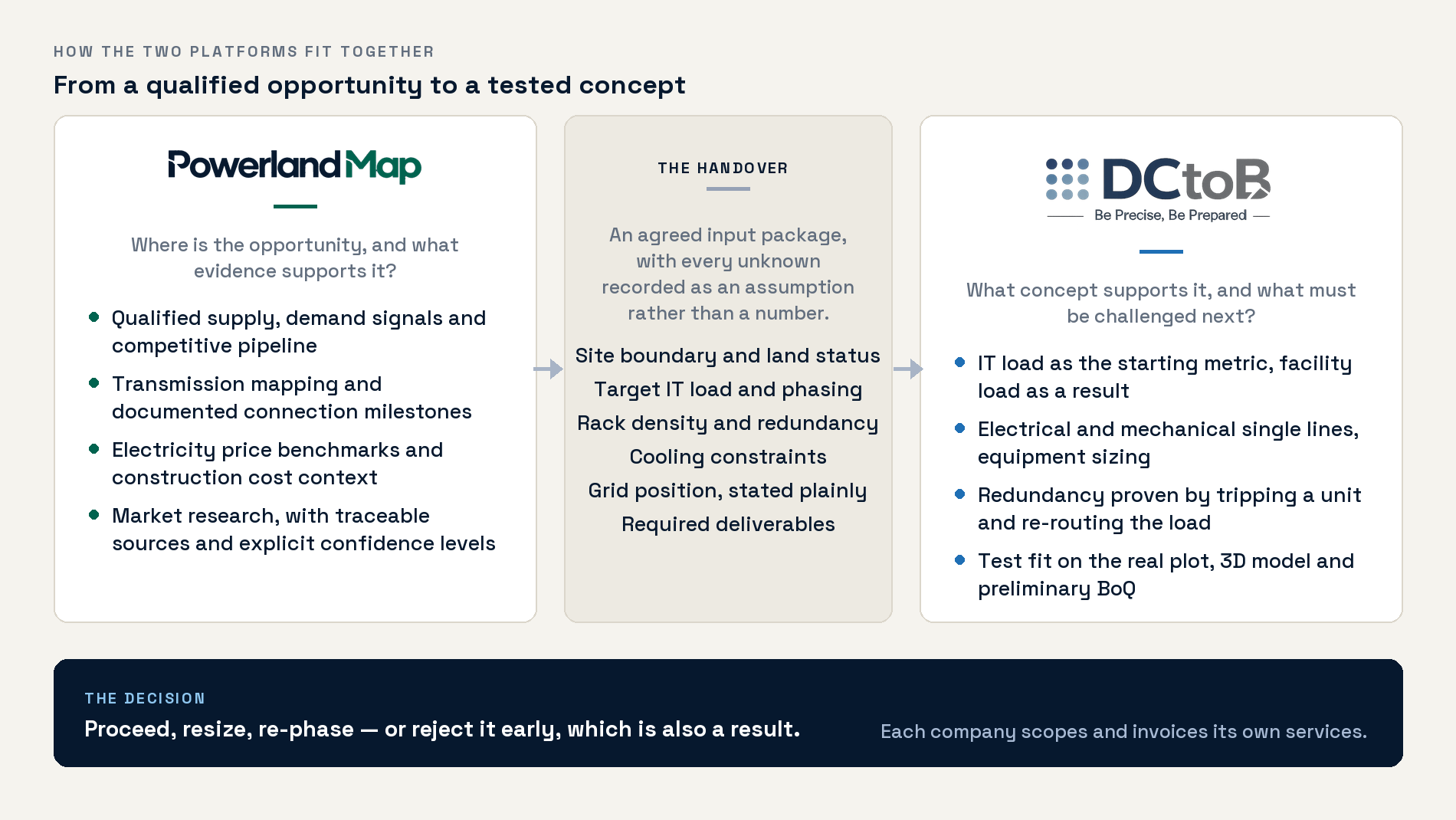
PowerlandMap: Finding Opportunities That Deserve Closer Examination
PowerlandMap is a market intelligence platform focused on global data center supply, power infrastructure, development opportunities and the evidence supporting capacity claims.
Its work begins upstream: identifying where infrastructure opportunities exist, separating announced projects from better-substantiated development propositions, and comparing site and market conditions. Its coverage spans operating, under-construction and proposed facilities, with evidence depth that varies by record and geography.
Market position and demand evidence
Supply intelligence makes it possible to screen existing facilities, expansion programmes, proposed campuses and competitive development pipelines. Matching Intelligence helps compare qualified supply opportunities with anonymised demand signals, subject to the underlying data and client requirements.
For an investor or developer, the question is not simply whether a city is popular. It is whether a particular opportunity can be distinguished from the announced pipeline in terms of timing, location, customer fit and evidence.
Power, grid and project-readiness intelligence
Electrical infrastructure is central to modern data center investment decisions. Transmission mapping, power-generation context and documented connection milestones can support an initial feasibility screen.
However, proximity to a substation is not a connection right. Requested grid capacity is not necessarily reserved capacity; reserved capacity is not necessarily energised capacity. PowerlandMap’s methodology keeps these distinctions visible so early development briefs are based on clearly described assumptions.
Economic context and market research
Electricity-cost analysis, construction-cost intelligence, market research and comparative market studies provide context for CAPEX, OPEX and investment screening. These are decision inputs rather than replacements for project-specific quotations or engineering cost plans.
Taken together, these layers are designed to answer: where is the opportunity, what evidence supports it, and what must still be verified before design and capital commitments?
DCtoB: Translating IT Load Into an Engineering Concept
DCtoB, developed by Dar Amman for Computer Programming LLC, provides a configurable data center conceptual design environment. Its platform links capacity planning with electrical and mechanical systems, drawings, 2D and 3D layouts, indicative equipment quantities and technical proposals.
Crucially, the starting capacity metric is IT load, not total facility power. Electrical and cooling topology, supporting equipment and assumptions about power usage effectiveness influence the facility load resulting from the design. This avoids presenting gross electrical capacity as equivalent to usable compute capacity.
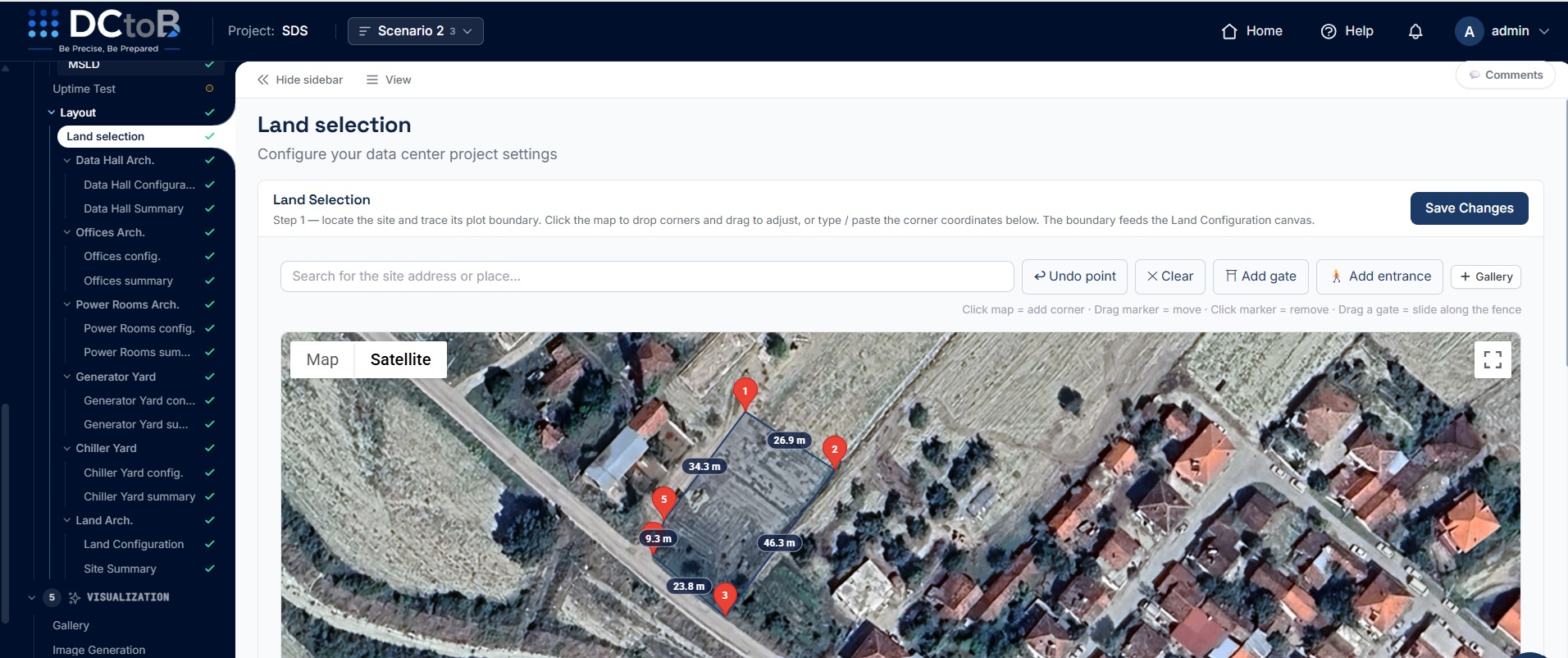
Starting from the real site
A concept begins on the actual plot rather than an abstract rectangle. The boundary is traced on the site, with corner dimensions, access points and gates, and that boundary then constrains every layout that follows. Setbacks, roads and resulting coverage are part of the model, because they frequently decide whether a target capacity fits a particular site at all. Where it does not, the platform shows what does: a reduced first phase, a different building arrangement, or a different plot.
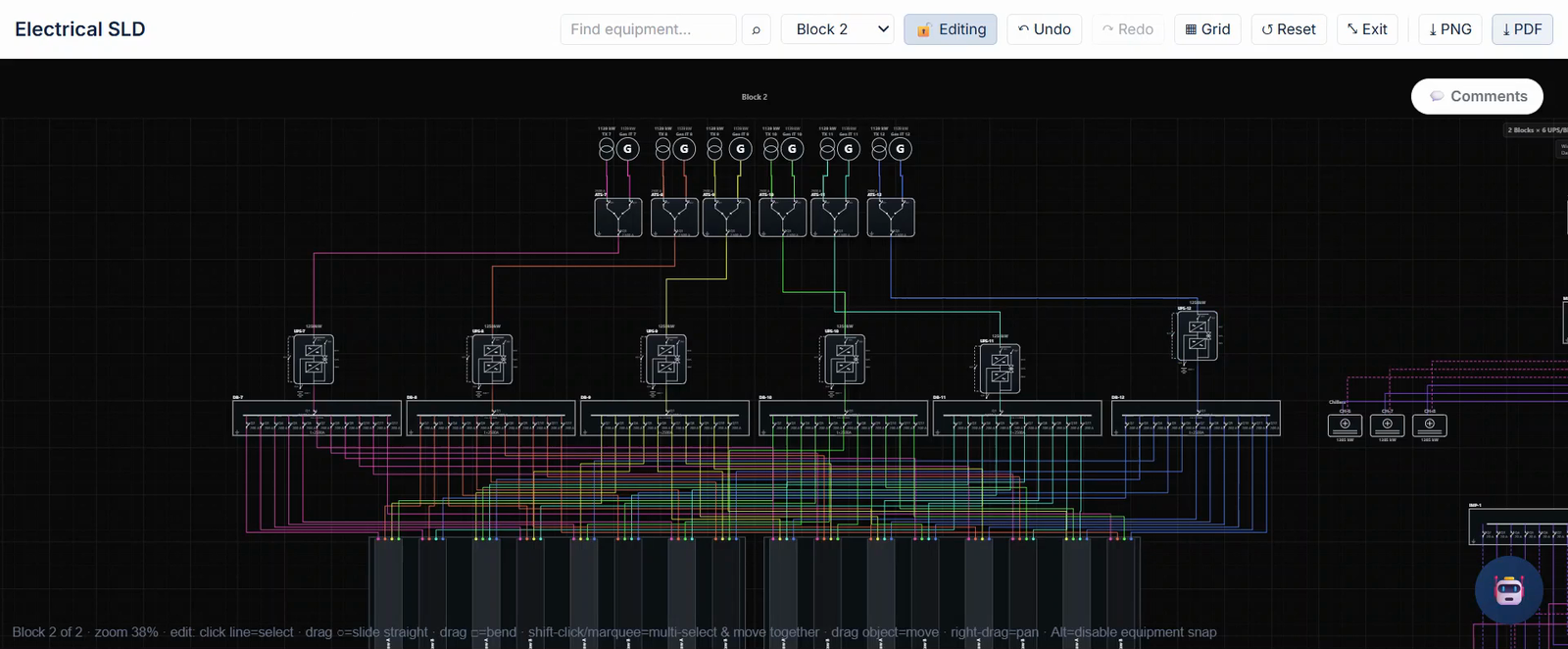
A coordinated electrical concept
DCtoB can organise the early-stage design of transformers, generators, UPS, distribution equipment and electrical single-line diagrams. Users can explore redundancy architecture and understand how equipment choices affect sizing and resilience assumptions.
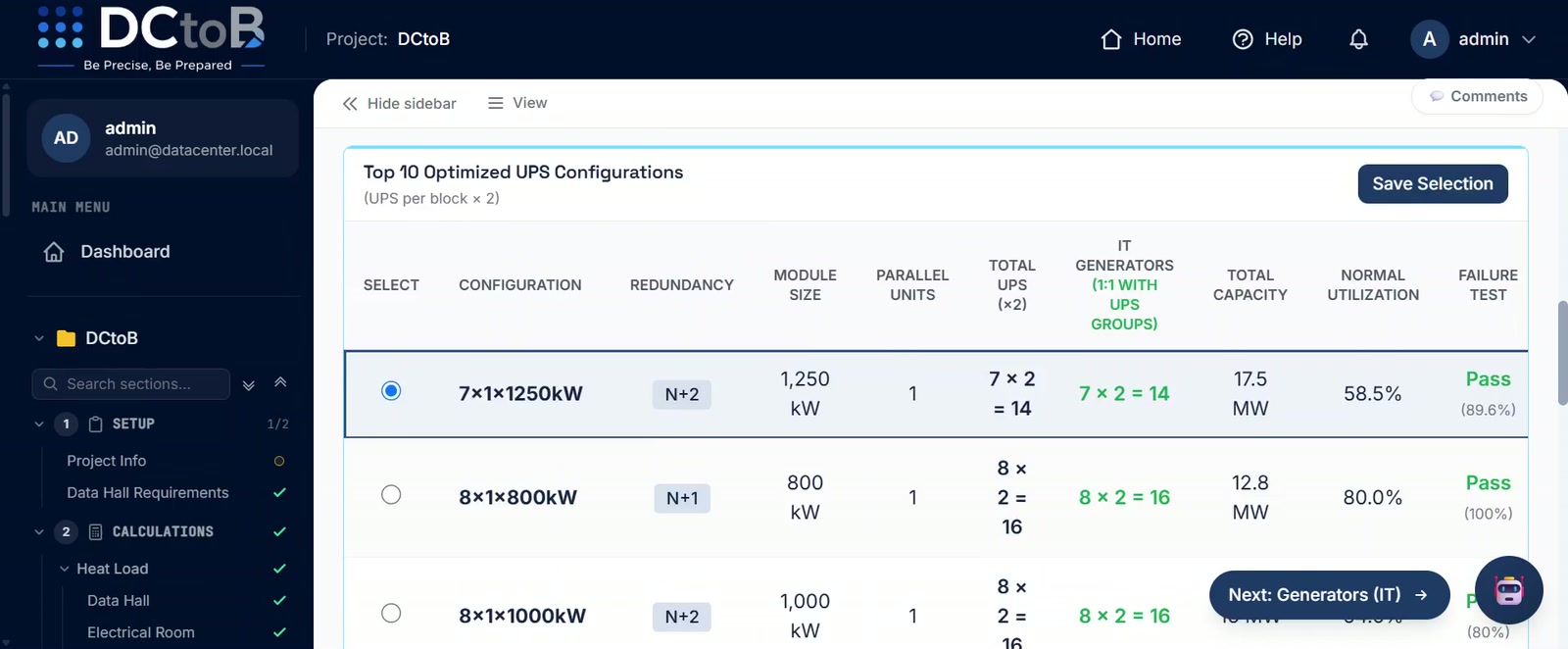
Redundancy that is tested, not asserted
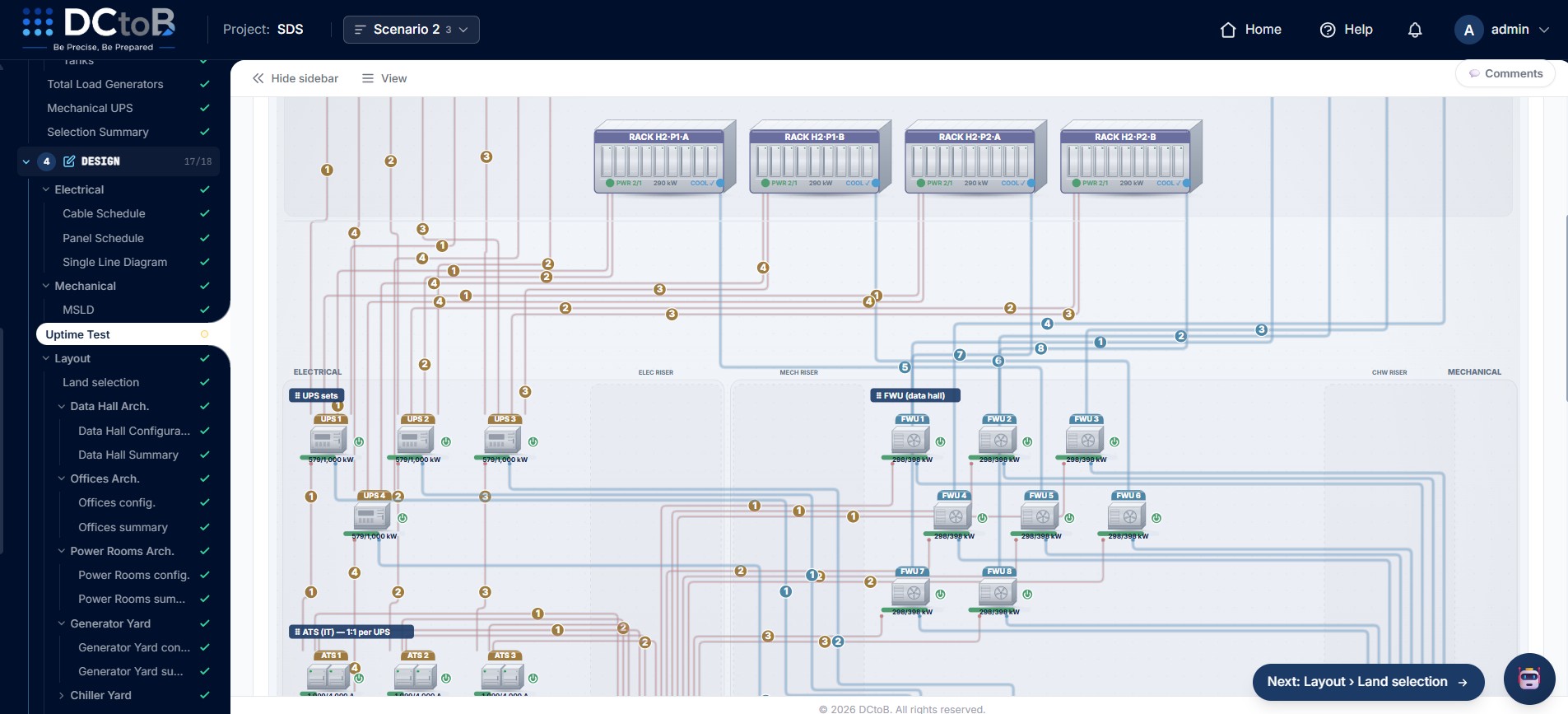
Redundancy is usually chosen as a label. N+1, 2N and a tier target appear in a brief, pass into a scheme, and are rarely traced through the distribution that is supposed to deliver them. DCtoB treats the claim as something to test. Candidate configurations are compared by redundancy, utilisation and the result of a failure test, and a user can remove a UPS module, a generator or a feeder in the model and watch where the load actually goes.
The same model drives an uptime test across the whole distribution, from source through UPS and PDU to the racks and the mechanical plant. A configuration that cannot carry the loss becomes visible at concept stage rather than at commissioning, and for an investor or an owner’s engineer reviewing an early scheme this is often the most useful half hour in the process.
These tests are conceptual modelling of the design as configured. They are not an Uptime Institute certification, a commissioning result or a guarantee of operational availability, and they do not replace the resilience testing carried out by qualified engineers at later design stages.
Cooling and mechanical requirements
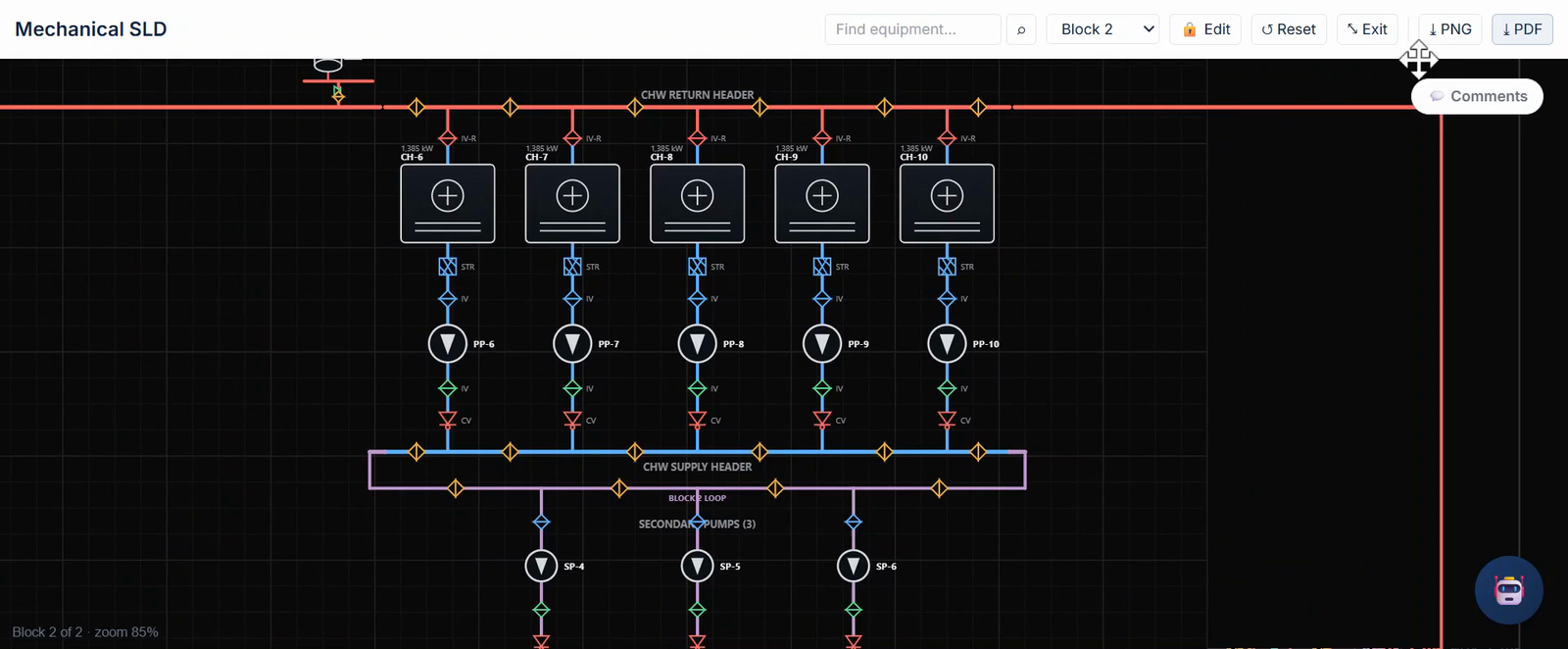
IT density, heat rejection and redundancy drive cooling architecture. DCtoB’s mechanical modules include cooling-load and flow calculations and conceptual configurations for relevant plant and distribution equipment. These can support discussion of options before detailed equipment selection, site surveys and discipline-specific design.
Spatial test-fit and project visualisation
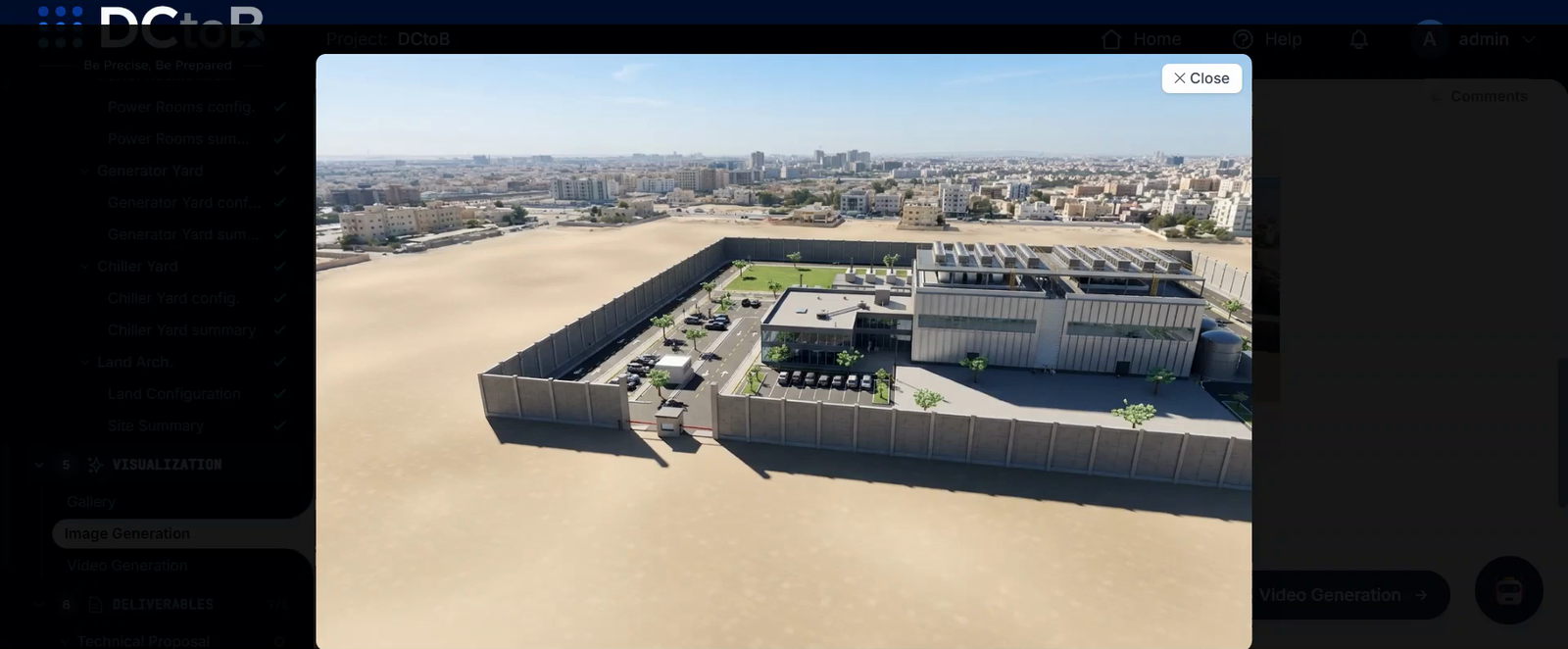
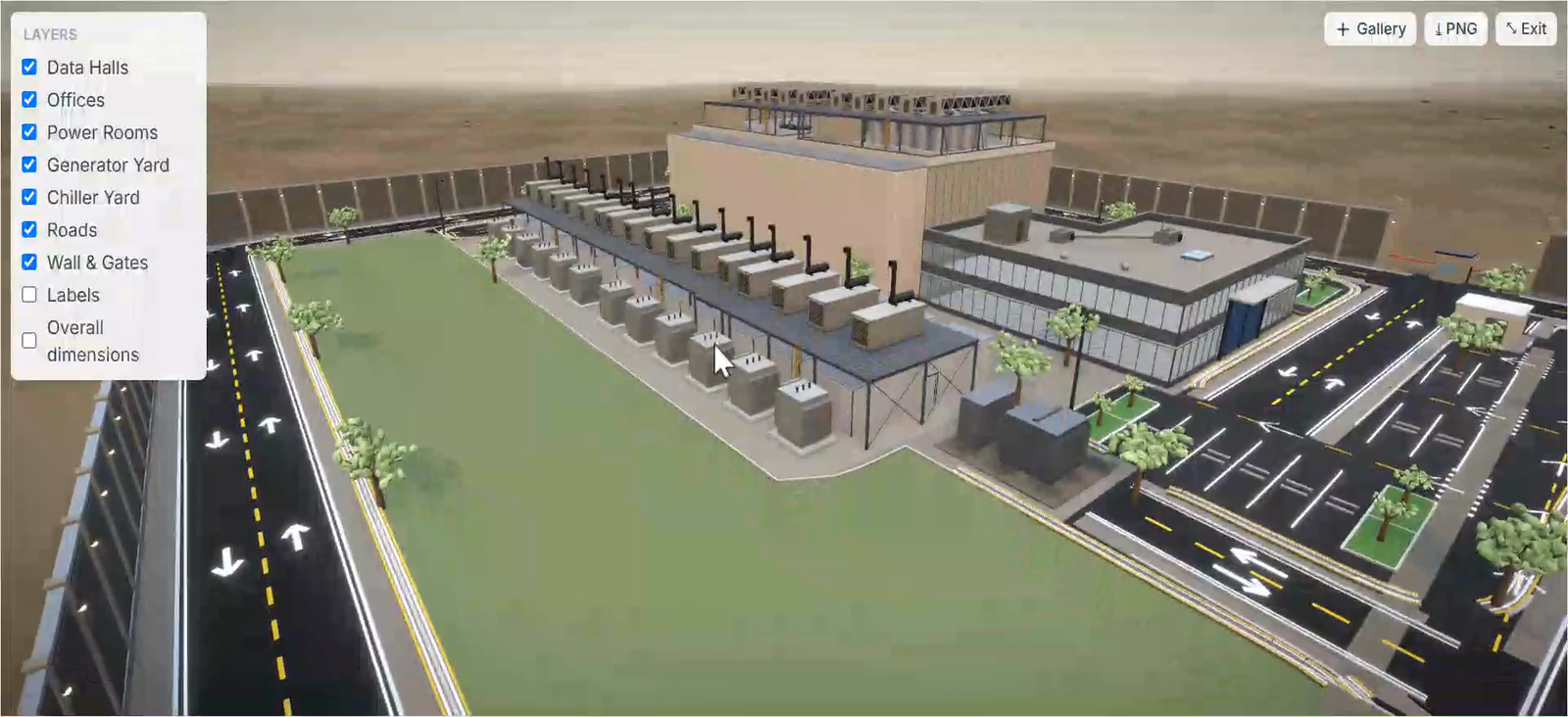
The platform brings system assumptions into 2D plans and 3D models so project teams can challenge technical footprints, equipment placement, data hall arrangements and site geometry. The same model also produces photoreal renders of the scheme, which teams use in investor and client presentations without commissioning separate visualisation work.
Quantities and budget implications
A preliminary bill of quantities can connect the conceptual configuration to indicative cost assumptions. When load, resilience or design configuration changes, the implications can be tested more systematically. A conceptual BoQ is not a contractor tender, an independently validated cost plan or a guaranteed construction price.
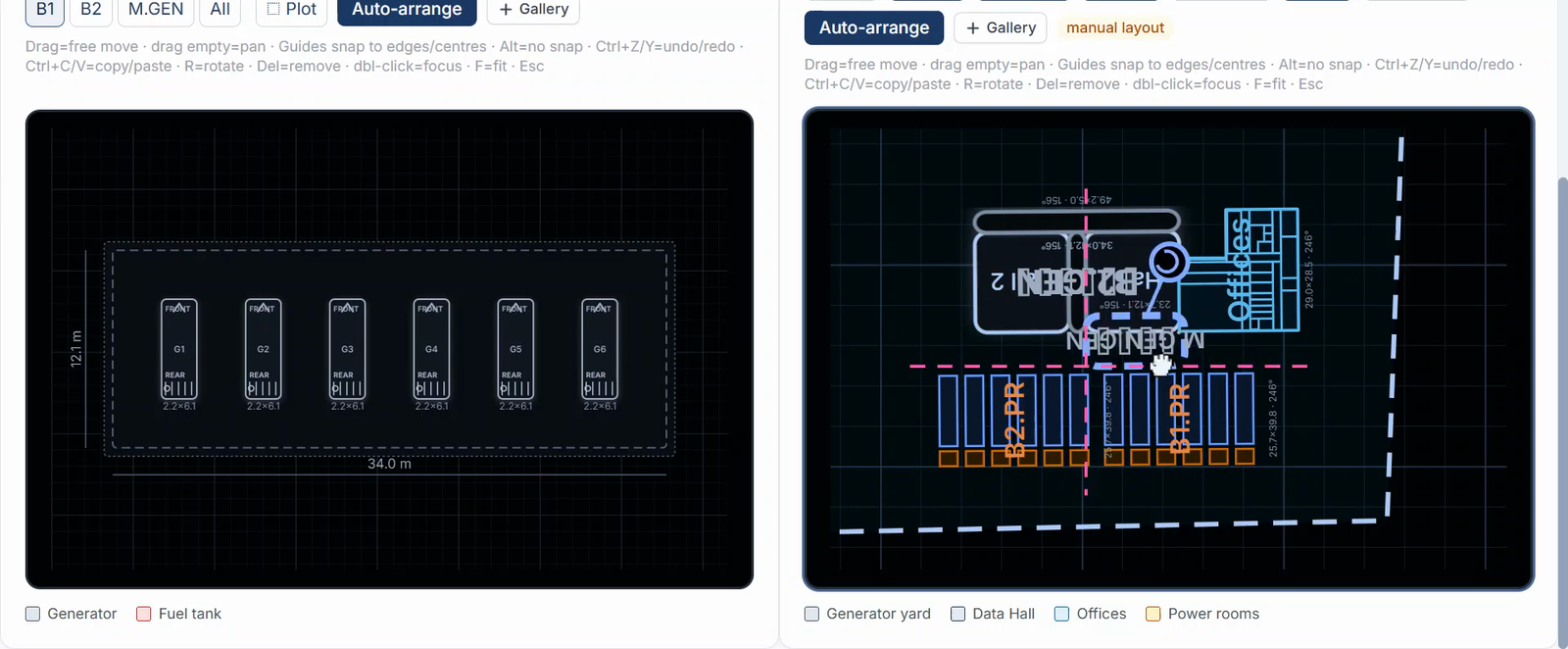
This creates a second decision point: what engineering concept might support the opportunity, and which assumptions should be challenged next?
A Clearer Handover from Site Screening to Concept Design
The collaboration is designed around a structured, human-reviewed workflow.
Identify the investment or development opportunity
A project team uses PowerlandMap intelligence to screen a market, a site, a portfolio or a potential expansion. The first output is a qualified opportunity and an explicit list of assumptions requiring confirmation.
Establish the power and development position
The team reviews site boundaries, land status, documented grid milestones, target IT capacity, phased requirements, permitting, commercial timing and material constraints. Unknowns are recorded rather than converted into false certainty.
Agree an engineering-ready project brief
Relevant assumptions are translated into an input package for technical scoping. Depending on the case, this can include IT MW, rack density, electrical redundancy, cooling constraints, building geometry, development phasing, ancillary space, site documentation and intended deliverables.
Explore and compare technical options
With an agreed scope, DCtoB can support conceptual assessment of electrical and cooling topologies, layouts, equipment quantities and resulting facility-level implications. Design output should be clearly distinguished from verified utility or permitting evidence.
Decide the next level of commitment
The combined commercial and technical evidence helps determine whether to move into additional surveys, formal utility work, professional design, due diligence or a different development scenario. Some opportunities may be rejected, phased differently or resized. That is a useful result of the screening process, not a failure of it.
Three Development Situations Where the Approach Matters
New campuses: power versus usable IT capacity
A greenfield campus might be advertised using a gross electrical capacity figure while its delivered IT load depends on cooling systems, resilience, support buildings and phasing. PowerlandMap can support the evidence-led assessment of the claimed power position and surrounding market. DCtoB can then explore the conceptual topology required to serve a specified IT target.
Retrofit projects: geometry and existing infrastructure
Brownfield conversions introduce uncertainty around as-built services, structural constraints, electrical reuse, plant replacement and physical access. Market intelligence helps explain the commercial opportunity, while a technical concept helps expose key fit and infrastructure questions. Retrofit is also where plot and building geometry bite hardest: a fixed envelope, an existing substation position and a constrained yard often decide the achievable IT load before any equipment is selected. Existing building information and site inspection remain indispensable.
AI and high-density infrastructure: density changes the design
AI-oriented workloads raise the importance of rack density, cooling architecture, power distribution and realistic delivery programmes. The development screen must reflect demand, power evidence and delivery timing, while conceptual design examines what equipment and spatial arrangements are implied by the target IT load.
In all three cases, the purpose is to expose material constraints earlier, not to claim those constraints have already been resolved.
An Illustrative Campus Scenario
Consider a developer assessing a hypothetical campus targeting 40 MW of eventual IT load, delivered in phases.
An initial market screen identifies relevant supply and demand patterns, existing infrastructure and apparent development opportunities. It also identifies gaps: for example, the extent to which grid capacity is only requested rather than contractually secured, and whether later phases require additional network works.
The developer prepares a scenario for the first IT phase alongside target resilience, cooling and rack-density assumptions.
DCtoB’s design environment can then be used to explore indicative electrical systems, plant footprints, data hall placement, supporting infrastructure and cost quantities. An alternative configuration might reveal greater supporting-power demand than initially assumed, or a more complex phasing requirement. Running the failure test against each candidate also shows whether the chosen redundancy survives the loss of a unit before that assumption reaches the investment case.
The team can then test the investment case again, decide which studies are necessary and determine whether to advance or revise the project.
This scenario is illustrative; it does not describe a completed joint assignment, a validated grid connection or a guaranteed facility design. Its value is the discipline of connecting an evidenced commercial hypothesis to an explicit engineering hypothesis.
A Partnership Built on Complementary Expertise
The two companies have agreed an opportunity-based framework for working together and introducing relevant opportunities. Their platforms remain distinct. Each party is responsible for scoping, contracting and invoicing its own services.
Potential clients can register their needs with PowerlandMap and request a coordinated discussion about market qualification and DCtoB’s conceptual design capabilities. Project-specific services, deliverables, support and timing are established through separate discussions and written proposals.
The partnership does not involve publication of client identities, protected demand records, confidential mandates or private site information. Any evaluation or demonstration should use appropriately authorised or fictional information, and commercial terms must be individually confirmed.
Nor is the collaboration presented as a fully automated data-transfer interface between the platforms. A reliable, reviewed handover is more important than suggesting an integration that has not yet been deployed.
The First Step in a Wider Partner Ecosystem
DCtoB is PowerlandMap’s first strategic technology partner. The milestone reflects our intention to connect market intelligence with practical capabilities further along the data center development chain, while maintaining clear professional and confidentiality boundaries.
For investors, it offers a more coherent way to challenge an opportunity before spending on deeper diligence. For developers, it can help translate market potential into a technical brief. For engineering firms and operators, it creates an additional route to better-structured project assumptions and coordinated early discussions.
We believe the most valuable innovation in digital infrastructure is not a larger map or a more elaborate rendering in isolation. It is a better decision: one that reconciles market reality, documented power, IT-load requirements, engineering options and capital commitment.
Work with PowerlandMap and DCtoB
Project sponsors, developers, operators, infrastructure investors, EPC contractors and engineering consultancies can explore the collaboration through PowerlandMap’s partner page or register a project for a scoped discussion.
PowerlandMap: powerlandmap.com · LinkedIn
DCtoB: dctob.co · LinkedIn · YouTube
PowerlandMap × DCtoB — from qualified market opportunity to informed conceptual design.
About PowerlandMap
PowerlandMap provides data center market intelligence covering qualified supply, power infrastructure, anonymised demand signals, electricity economics, development opportunities and market research. Its role is to help clients screen and interpret opportunities using traceable evidence and explicit confidence boundaries.
About DCtoB
DCtoB is a data center conceptual design and test-fit technology platform developed by Dar Amman for Computer Programming LLC. Its integrated workflow supports capacity definition, electrical and mechanical calculations, single-line diagrams, redundancy and uptime testing, plot test-fit, 2D/3D layouts and photoreal visualisation, preliminary bills of quantities and technical proposal preparation.
The data behind the analysis
Follow Partnerships with sourced, dated evidence
Qualified supply, anonymised demand and evidence-based matching sit behind each read — with the source, confidence level and verification date on every record
Related analysis
Power Is Becoming the New Collateral for AI Infrastructure
AI infrastructure finance is shifting toward secured power, phased capacity and contracted demand. Here is what makes a powered site bankable.
Grid-Interactive Data Centers Are Becoming a Capacity Strategy
Grid interaction is moving from an energy-management topic to a capacity strategy. The useful question is not only how many megawatts are connected, but how a campus can operate within the constraints of the power system.
A Market Study Should Change a Decision
PowerlandMap’s market studies are built around specific data center decisions: where to deploy, what capacity is real, when power can arrive, and which projects deserve attention.